'%3e%3crect%20width='624'%20height='128'%20fill='white'/%3e%3cpath%20fill-rule='evenodd'%20clip-rule='evenodd'%20d='M0%2011.3137V128H116.686L0%2011.3137ZM128%20113.858V0H14.1421L128%20113.858Z'%20fill='%23FFCD4B'/%3e%3ccircle%20cx='234'%20cy='64'%20r='64'%20fill='%236E3CFF'/%3e%3cpath%20d='M393.5%201L464.081%20127.75H322.919L393.5%201Z'%20fill='%2327FCAF'/%3e%3cpath%20fill-rule='evenodd'%20clip-rule='evenodd'%20d='M624%200H496V56H624V0ZM624%2072H496V128H624V72Z'%20fill='%23FA41F2'/%3e%3c/g%3e%3cdefs%3e%3cclipPath%20id='clip0'%3e%3crect%20width='624'%20height='128'%20fill='white'/%3e%3c/clipPath%3e%3c/defs%3e%3c/svg%3e)
Nanjing Travelogue
I’m here in Nanjing for a few weeks, visiting my girlfriend’s family, and doing a bit of touristing.
Celebrating 1912
We went to a square called 1912, so named for its historical significance as the place where Sun Yat-sen established the Republic of China and was inaugurated as its first President.
When I was here four years ago, it was a bar/club district, and a lame one at that — visiting at that time reminded me that most of what I like about cocktail bars in San Francisco is having a nice venue to hang out in the evening. These days, the square is full of coffee and tea places that are open late, which are honestly preferable to me.
As we approached the entrance of 1912, we saw this cool sculpture:
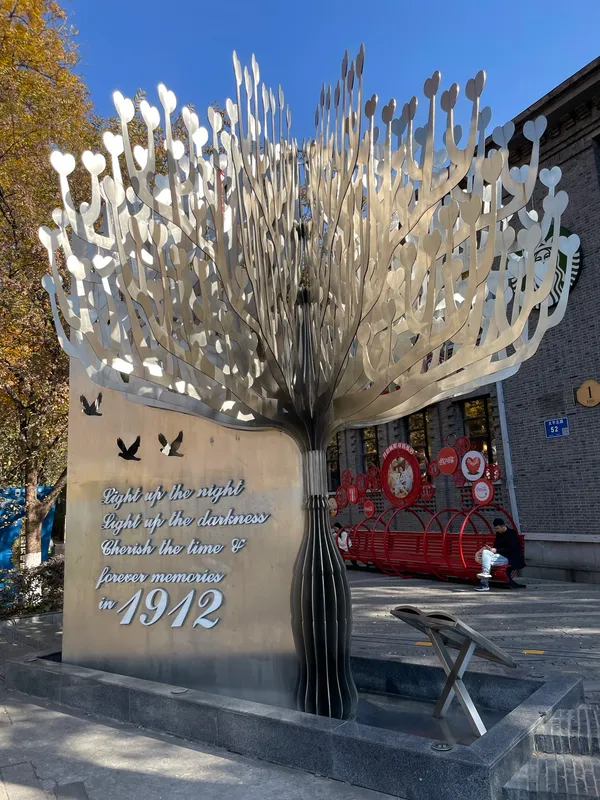

I was surprised to see the other side of it:
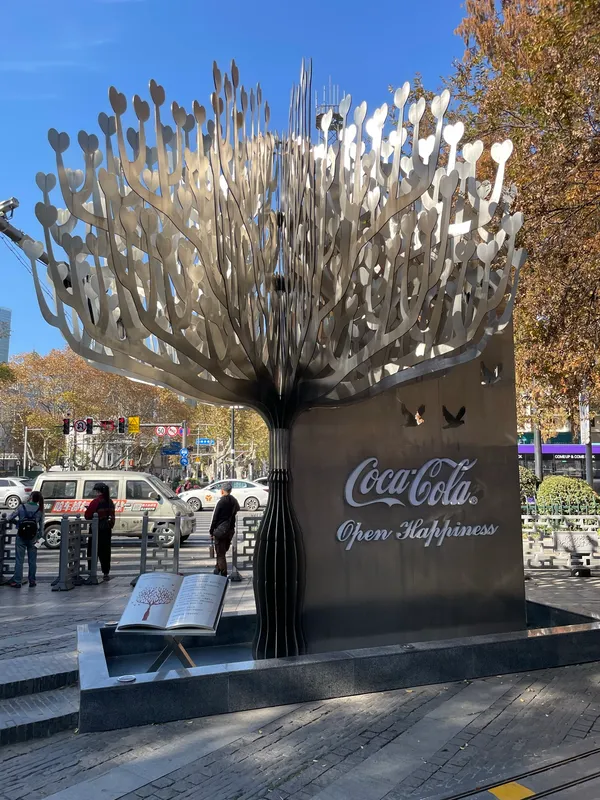

I really want to know whether this is a permanent installation. I mean, it looks permanent. But installing a permanent ad is pretty impressive.
Possibly interesting is the celebration of 1912, the founding of the Republic of China (as opposed to the Peoples’ Republic of China). You might think that this amounts to a celebration of the government that ultimately decamped to Taiwan, and that’s probably what the nationalists in Taiwan would say. But the 1912 government, while notable as the first post-Imperial government, never really got off the ground. I think it’s easy to write off the 1912 government as just a passing phase — certainly that is the impression I got from reading The Search for Modern China, the seminal Western history of modern China.
I also suspect that, politically, what’s going on here is that Nanjing has a history far longer than the CCP (founded 1921), and so Nanjing gets a bit of a pass on celebrating its own history. Celebrating 1912 in Beijing might not be so well-received.
I guess I love this installation as an embodiment of the idea that the situation on the ground is always more complicated than it might seem from afar.
Mechanical Computers in Ancient China
We went to a museum where I saw reconstructions of two mechanical computing devices from ~2000 years ago that I had previously heard of before but never seen in detail:
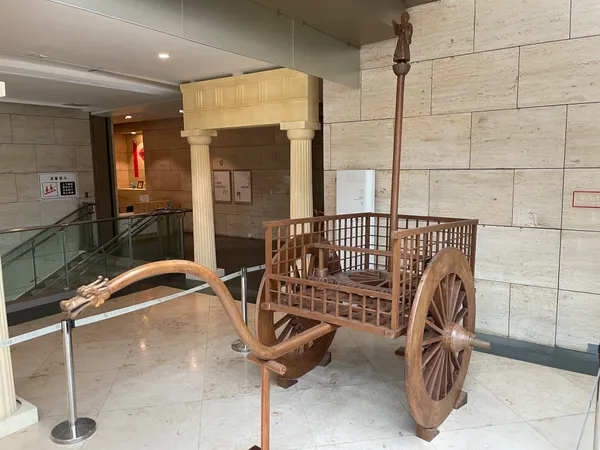

This is the South-Pointing Chariot. It uses a differential gear to cause the statue on the top to rotate in the opposite direction of the cart — that is, if the cart rotates 10° clockwise, the pointer rotates 10° counterclockwise. Thus, by dead reckoning, it always points the same direction.
Here is a somewhat similar device:
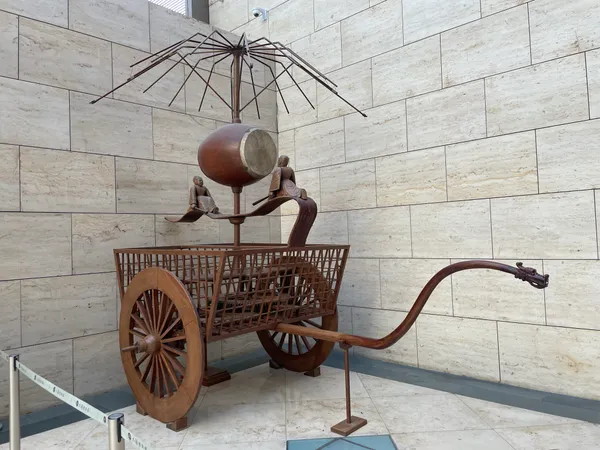

This one is a big odometer: every 500m or so, those statues on top beat the drum to let you know how far you’ve traveled.
You can read more about these devices, including historical sources, on the Wikipedia page for the South-pointing chariot.
Historical towns
Because Imperial China lasted so long, and modernization/industrialization happened so late here, there are a lot of well-preserved historical towns that have become tourist attractions, their stores and stalls now populated by restaurants, street food, and the sorts of knickknacks sold to tourists everywhere.
Yesterday we went to Zhènjīang. As a quick lesson on Chinese cities, these three cities in the same province (Jiangsu), all on the same river:
- Shanghai (pop: 22m), the biggest city in the world, is like New York (20m): it’s the infinite city, there’s so much going on there that no matter what you’re looking for, you’ll find it.
- Nanjing (pop: 7.5m), where I am now, is like Boston (4.9m): historically significant, filled with dozens of universities (including the preeminent theological seminary in China), noticeably smaller than Shanghai.
- Zhenjiang (pop: 3.2m) is maybe like… Pittsburgh (2.3m)? Previously historically significant, now much less important than it used to be. (To be honest, I don’t understand the decline of either Zhenjiang or Pittsburgh.)
Today Zhenjiang is still a real city where people live and work, but the historic town is a tourist attraction. Miscellaneous pictures follow:
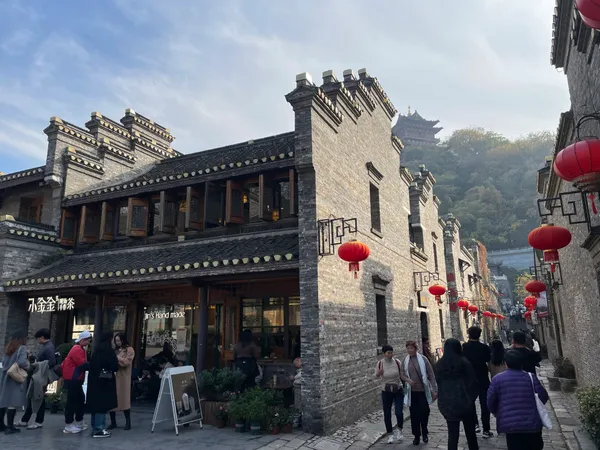

The architecture of this shop is very cool. Today, it sells boba tea.
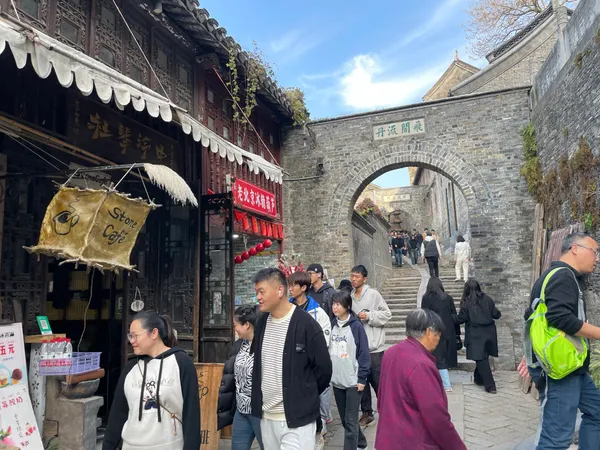

Part of the town is a walled city on a hill, not unlike similar European medieval cities.
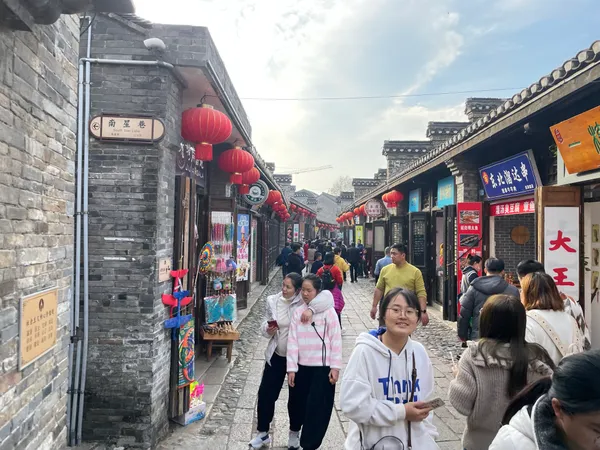

Honestly I really like the pre-modern buildings filled with modern people and shops.
Big towers, empty skies
On the way back, we stopped by a semi-rural community that is basically just a bunch of high rise apartment buildings, with retail/food on the first floor (grocery, supermarket, drugstore, various casual restaurants), and a high-speed rail (20min to downtown Nanjing, 1hr to Shanghai). Otherwise, it’s kind of in the middle of nowhere. It’s surrounded by a mixture of undeveloped land and suburban houses.
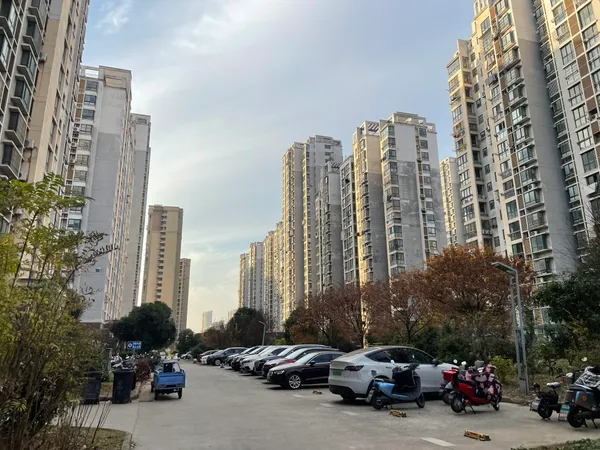

These are probably the closest that humanity has gotten to building arcologies. I’d theoretically be happy to live there (cheap, convenient, access to the city) but it feels weirdly empty and kinda sad. And this mismatch is mildly confusing to me.
A truck stop in China
Before yesterday, I’d only ever been to big cities in Asia, plus small towns accessible by train in Taiwan and Japan. I mean, I knew they had rural farming communities, which in the modern era must be serviced by automobiles, but I never really thought about it. I thought of long car trips, complete with rest stops, as a completely American thing.
So imagine my surprise when, on the way back, we pulled into this truck stop:
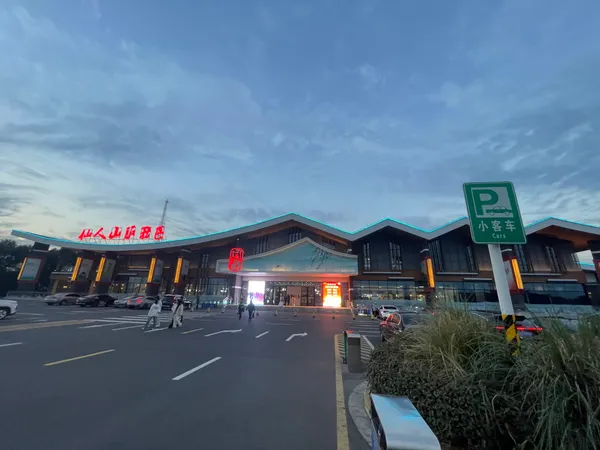

You know, a truck stop that has a gas station and a few restaurants and a convenience store and about a hundred stalls in the bathroom. That’s clearly what it is, even from the outside! And the inside is exactly like one of those big rest stops on the 15 in the middle of nowhere in California, too, complete with weirdly wide corridors because land is cheap because it’s in the middle of nowhere. It has all the same constraints, so it shouldn’t be surprising that the design is about the same, except with Chinese food instead of Popeyes, and a few Asian architectural flourishes on the exterior.
One of the patrons there even walked, not with the tight compact steps of Asian city-dwellers, but the wide rolling gait that I associate with Midwestern Americans!
This reminds me of when I went from high school in California to college on the East Coast: people asked me if it felt different, but, culturally, moving from suburban San Diego to suburban Boston was much less of a change than when I had previously moved from rural Ohio to suburban San Diego. That is, the urban/suburban/rural divide is much more salient than geographical distance.
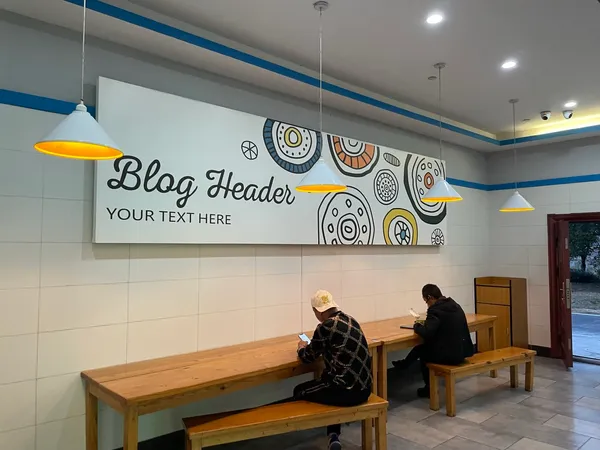
One last picture: you’ve probably seen cheap design work where someone copies a header image to use elsewhere. And you’ve probably seen cases where somebody left in the template text unchanged. But I’ve never seen it like this: